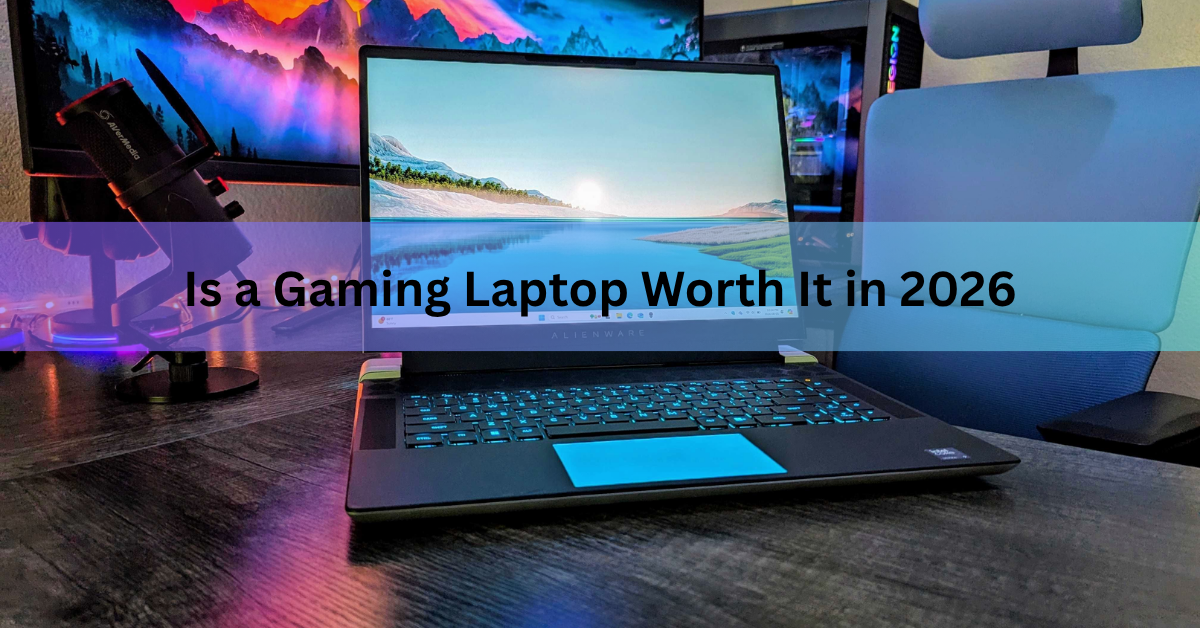
A gaming laptop is worth it if you need to play games in more than one place and you buy in the middle of the price range. If you only ever game at one desk, a desktop gives you more speed for the same money and lasts longer.
Everything else comes down to three questions: where you play, how much you can spend, and how long you want the machine to last. Prices also shifted a lot in 2026, so the math looks different than it did a year or two ago. Here’s how to work it out for your own situation.
Who should buy a gaming laptop?
A gaming laptop makes sense when portability is the main reason you’re buying it, not a nice extra. It’s one machine for school, work, and games, and it fits in a backpack when you move.
| A gaming laptop is worth it if you… | You’re better off skipping it if you… |
| Move between places, like home and a dorm | Play at the same desk almost every time |
| Need one computer for work or school and games | Want maxed-out 4K graphics with ray tracing |
| Travel and want to play in hotel rooms | Like upgrading parts every few years |
| Play mostly at 1080p or 1440p | Need all-day battery life away from a socket |
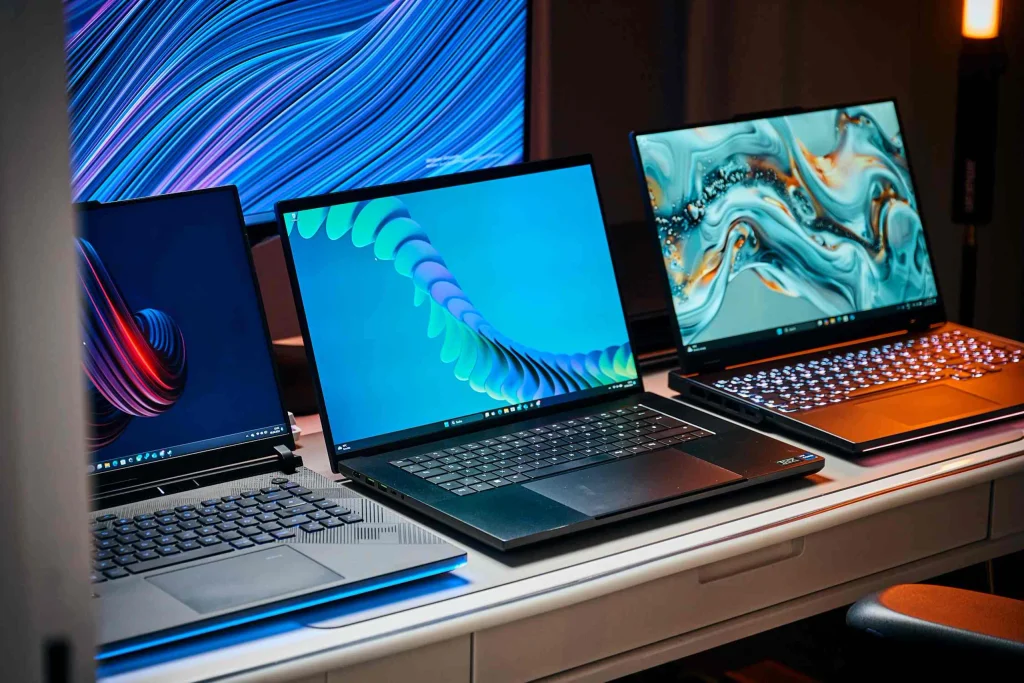
Ray tracing is a lighting effect that makes games look more real but needs a lot of graphics power. That power is exactly what laptops are short on.
Here’s a simple test. Think back over the last month. If a laptop would have left your desk only once or twice, you’d be paying extra for portability you don’t really use.
How much slower is a gaming laptop than a desktop?
A gaming laptop is slower than a desktop with the same graphics chip name, and the gap grows as you move up the range. At the very top, the laptop RTX 5090 runs at roughly half the speed of the desktop RTX 5090.
The reason is power and heat. The desktop RTX 5090 is rated at 575 watts. The laptop chip with the same name is set somewhere between 95 and 175 watts, because a thin case can only push out so much heat. Less power means lower clock speeds, and lower clock speeds mean fewer frames per second. In real games, the top laptop chip performs close to a desktop RTX 4070 Ti, a card from the previous generation.
The gap shrinks a lot in the middle of the range. Chips like the laptop RTX 5060 and RTX 5070 run much closer to the power of their desktop versions, so the difference at 1080p is far smaller. That’s why mid-range laptops give you the most game for your money, while the priciest models give you the least.
Price follows the same pattern. For the cost of an RTX 5080 laptop, you can buy a desktop with a faster graphics card and still have money left for a good monitor. Keep in mind, though, that the laptop price also covers a screen, keyboard, speakers, and battery, so the real gap at the entry level is smaller than it first looks.
Tip: Two laptops with the same GPU name can perform very differently. Look for the TGP (total graphics power, measured in watts) on the spec sheet. A 115-watt RTX 5060 often beats a 95-watt RTX 5070 in real games.
You can see every laptop chip in the current lineup and what it supports on Nvidia’s RTX 50 Series laptop page.
What are the real downsides?
The main trade-offs are short battery life, heat and noise, weight, and limited upgrades. None of them rule a gaming laptop out, but you should know them before you pay.
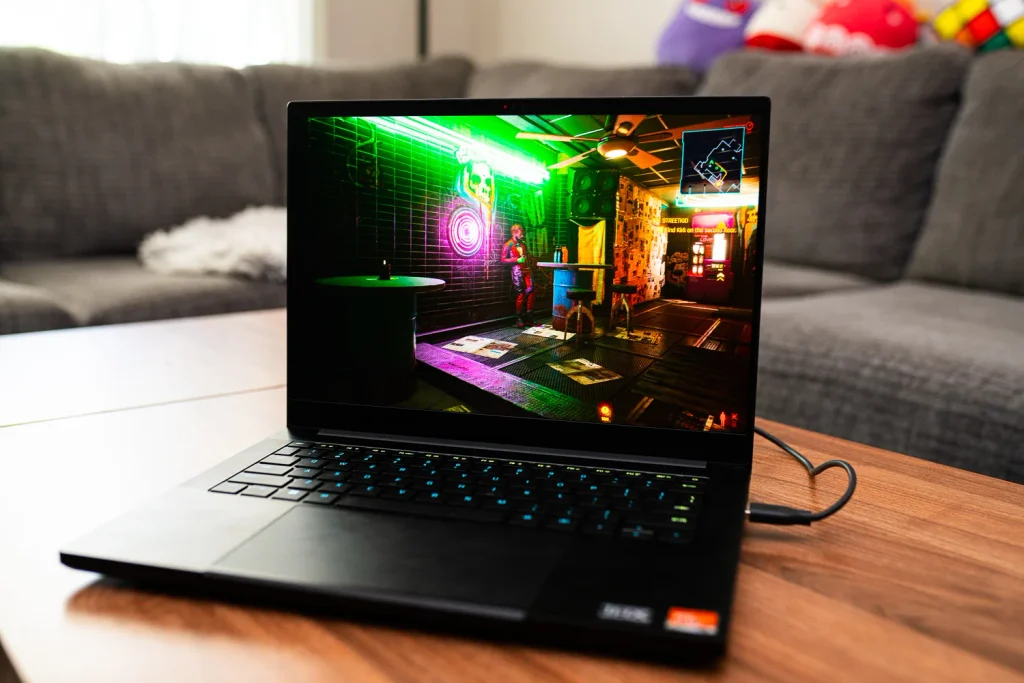
- Battery life. On battery, a gaming laptop slows itself down on purpose. Many cut the graphics chip to about a third of its full power, so frame rates drop hard. Even then, a gaming session unplugged usually lasts only an hour or two. For real play, you’ll want to sit near a socket.
- Heat and noise. Under load, the fans spin up and get loud, often loud enough that you’ll reach for headphones. Thinner models also get warm around the keyboard.
- Weight. Most 16-inch gaming laptops weigh around 2.2 to 2.8 kg (about 5 to 6 pounds), plus a large power brick. That’s fine for a backpack, but you’ll feel it at the end of a long day.
- Upgrades. You can usually add more RAM (the short-term memory your computer works from) and a bigger SSD (the storage drive). Some thin models solder the RAM to the board, so check first. The graphics chip and processor can never be swapped. When the GPU gets old, the whole laptop gets old.
- Lifespan. A mid-range gaming laptop usually handles new games well for about four to five years, with settings turned down toward the end. A desktop can last longer because you can replace just the graphics card.
Is there a cheaper way to get what you want?
Often, yes. The right choice depends on why you wanted a gaming laptop in the first place.
- A desktop plus a basic laptop. If you game at home and only carry a laptop for notes and email, this pair can cost about the same as one mid-range gaming laptop and plays games better.
- A handheld gaming PC. Devices like the Steam Deck run many PC games on the go for much less money, at lower settings.
- Cloud gaming. A service like GeForce NOW runs games on remote servers and streams them to an ordinary laptop. You need fast, steady internet and a monthly plan.
- A console. If you mostly play big releases on a TV, a console is simpler and cheaper than any gaming laptop.
How much should you spend, and on what?
Plan on about $1,000 to $1,500 for a solid gaming laptop in 2026, and up to about $2,200 if you want smooth 1440p. Rough price ranges by tier look like this:
| Tier | Typical GPU | Rough price (USD) | Good for |
| Entry | RTX 5050, RTX 5060 | $900 to $1,500 | 1080p at high settings |
| Mid-range | RTX 5070, RTX 5070 Ti | $1,300 to $2,200 | 1440p at high frame rates |
| High-end | RTX 5080, RTX 5090 | $2,200 to $4,200 | 1440p maxed out, some 4K |
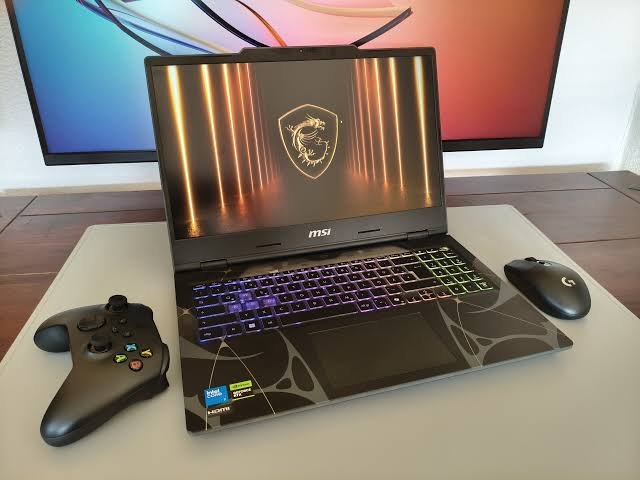
Prices are higher than usual because of a global memory shortage. AI data centers are buying up huge amounts of RAM and storage chips, so laptop makers pay more for the same parts and pass the cost on. Dell, HP, and Lenovo all raised prices heading into 2026, and the shortage has no clear end date. Waiting for a big price drop is a risky bet right now. If a well-reviewed model fits your budget and goes on sale, it usually makes sense to buy.
Once you’ve set a budget, these are the specs that change how games actually feel:
- GPU and TGP. This matters more than anything else. Pick the highest-wattage version of the chip you can afford.
- Memory. 16GB is the minimum. For an RTX 5070 Ti or higher, 32GB is worth paying for.
- Screen. A 16-inch 1440p panel at 165Hz or faster suits mid-range chips. Entry chips pair well with a 1080p, 144Hz screen.
- Storage. Get at least 1TB. Many big games now take 100GB or more each.
- Cooling. Check reviews for how hot and loud the laptop gets in long sessions, not just its peak speed.
Frequently asked questions
How long does a gaming laptop last?
A mid-range gaming laptop usually plays new games well for about four to five years, with lower settings toward the end. It can run older and lighter games much longer. Adding RAM or storage helps, but the graphics chip can’t be upgraded.
Is a gaming laptop good for school or work?
Yes, especially for heavy tasks like video editing, 3D work, or coding. The trade-offs are weight, fan noise, and shorter battery life than a regular laptop. If you mostly type and browse, a lighter laptop will feel nicer every day.
Is a $1,000 gaming laptop worth it?
Yes, if it has an RTX 5050 or RTX 5060 at a decent TGP, 16GB of memory, and at least 512GB of storage. That handles 1080p gaming well. Skip older graphics chips at this price unless the discount is large.
Can you game on a gaming laptop without plugging it in?
You can, but performance drops a lot. On battery, the laptop cuts power to the graphics chip to save charge, so frame rates fall and sessions usually last an hour or two. Plug in for anything demanding.
Should I wait for gaming laptop prices to drop?
Probably not. The memory shortage behind 2026’s price rises has no clear end date, so prices may stay high for a while. If a well-reviewed model fits your budget and goes on sale, buying now is usually the safer choice.
Conclusion
A gaming laptop is worth it when you truly need to play in more than one place and you buy in the middle of the range: an RTX 5060 to RTX 5070 Ti with a high TGP, for roughly $1,000 to $2,000. If you almost always game at one desk, a desktop gives you more speed per dollar and lasts longer. A good buy is a laptop you actually carry, plug in to play, and use happily for four to five years.
Recommended Articles:
Why Laptop Barrel Chargers Are Bigger Than USB-C
How to Select a Desktop Computer: A Step-by-Step Guide for 2026
How to Make Your PC a Touch Screen (What Actually Works in 2026)
Can Your Employer Listen to You Through Your Laptop Microphone?