The RTX 4070 laptop GPU is the faster chip. At full power, it beats the RTX 5050 laptop GPU by roughly 20 to 30 percent in most games, and the gap can stretch further in heavy synthetic tests. If both laptops cost about the same, buy the 4070.
The 5050 earns its place a different way. It costs less, draws less power, uses faster GDDR7 memory, and supports DLSS 4 with Multi Frame Generation, which the 4070 never gets. So the real question is not which chip is stronger. It is whether the 4070’s raw speed is worth the extra money over a newer, more efficient card. Here is everything you need to decide.
Specs at a glance
The two GPUs come from different generations. The RTX 4070 laptop GPU launched in February 2023 on the Ada Lovelace architecture. The RTX 5050 laptop GPU arrived in mid 2025 on the newer Blackwell architecture, as the entry point of the RTX 50 series.
| Spec | RTX 5050 Laptop GPU | RTX 4070 Laptop GPU |
| Architecture | Blackwell (2025) | Ada Lovelace (2023) |
| CUDA cores | 2,560 | 4,608 |
| RT / Tensor cores | 20 (4th gen) / 80 (5th gen) | 36 (3rd gen) / 144 (4th gen) |
| VRAM | 8 GB GDDR7, 128-bit | 8 GB GDDR6, 128-bit |
| Memory speed / bandwidth | 24 Gbps / 384 GB/s | 16 Gbps / 256 GB/s |
| Power range (TGP) | 35–100 W (+15 W Dynamic Boost) | 35–115 W (+ up to 25 W Dynamic Boost) |
| Frame generation | DLSS 4, Multi Frame Generation | DLSS 3, single frame generation |
| Typical role | Budget 1080p gaming | 1080p high refresh and 1440p gaming |
The core counts tell most of the raw performance story. The 4070 carries 4,608 CUDA cores against the 5050’s 2,560, which is 80 percent more shader hardware. No amount of architecture polish closes a gap that wide.
What the table hides is the memory swap. The 5050 uses GDDR7 at 24 Gbps, which pushes 384 GB/s of bandwidth through the same 128-bit bus where the 4070 manages 256 GB/s with its 16 Gbps GDDR6. That is 50 percent more bandwidth on the cheaper card.
How much faster is the RTX 4070 laptop in games?
At comparable full-power settings, the RTX 4070 laptop GPU delivers around 20 to 30 percent higher frame rates in real games, and some aggregate benchmark scores put the gap closer to 40 percent. A useful shortcut: the 5050 laptop GPU performs at about the level of the older RTX 4060 laptop GPU, and the 4070 sits roughly one full tier above that.
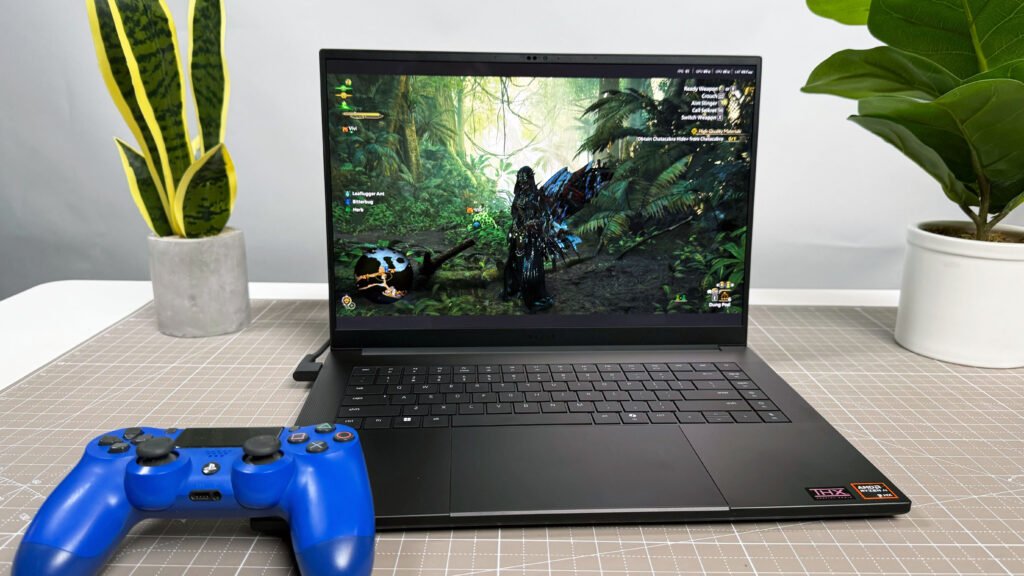
In practice, that tier matters most at higher resolutions and refresh rates. A full-power 4070 handles 1440p gaming at high settings in most titles and pushes well past 100 fps at 1080p in popular esports and AAA games. The 5050 is best treated as a strong 1080p card. It runs modern releases smoothly at high settings in 1080p, and it can stretch to 1440p in lighter games or with upscaling, but it lacks the shader muscle for native 1440p in demanding titles.
Ray tracing follows the same pattern. The 5050 carries newer 4th generation RT cores, but only 20 of them against the 4070’s 36. When you switch ray tracing on, the raw core advantage wins, and the 4070 stays ahead.
Where the RTX 5050 fights back
The 5050 is not just a cheaper, slower chip. It brings four real advantages that come from being two years newer.
DLSS 4 with Multi Frame Generation. This is the big one. The 5050 can generate up to three AI frames for every rendered frame in supported games, while the 4070 tops out at DLSS 3’s single generated frame. In a game with full DLSS 4 support, a 5050 can put more frames on screen than a 4070, even though the 4070 renders more of them natively. Frame generation adds a little latency and works best when the base frame rate is already decent, so it does not fully replace raw power. But on a 144 Hz or 165 Hz laptop screen it makes games feel far smoother than the spec sheet suggests. NVIDIA lists the full feature set on its official RTX 5050 announcement page.
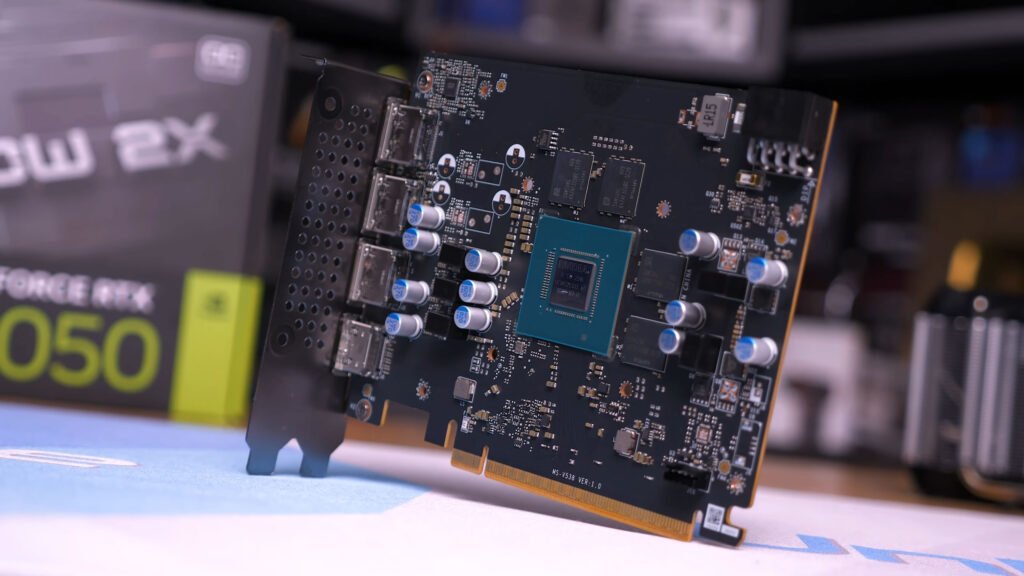
Faster, more efficient memory. GDDR7 gives the 5050 its 384 GB/s of bandwidth and does it while drawing less power than GDDR6. That helps in bandwidth-hungry moments, like streaming high resolution textures, and it helps battery life and thermals.
Lower power, thinner laptops. The 5050 tops out at 100 watts plus 15 watts of Dynamic Boost, for 115 watts total. The 4070 scales up to 115 watts plus as much as 25 watts of boost, reaching 140 watts. That extra headroom is part of why the 4070 is faster, but it also means 4070 laptops need bigger cooling. The 5050 fits into machines as thin as 15 mm and as light as 1.3 kg, which the 4070 rarely manages without heavy throttling.
Newer media engines. The 5050 ships with NVIDIA’s 9th generation encoder (NVENC), a step up for anyone who streams gameplay or edits video, with better quality at the same bitrate than the 4070’s older encoder.
Wattage matters more than the model name
Here is the trap most buyers fall into: two laptops with the same GPU sticker can perform very differently. Laptop makers configure each chip within a power range, and the range is wide.
The RTX 4070 laptop GPU can be set anywhere from 35 to 115 watts, with boost clocks that run from about 1230 MHz at the bottom of that range up to 2175 MHz at the top. A 60 watt 4070 in a thin machine loses a huge slice of its performance, enough that a full-power 5050 gets uncomfortably close to it. The 5050 has the same issue on a smaller scale, with a 35 to 100 watt range.
So before you compare these two GPUs, compare the actual laptops. Check the spec sheet or the maker’s product page for the exact TGP, and treat anything below roughly 90 watts on the 4070 as a slower card than the benchmarks suggest. Notebookcheck’s RTX 4070 laptop GPU database shows how specific models perform at their real wattage.
Two rules save most of the pain here. A high-wattage lower-tier chip often beats a starved higher-tier chip, and cooling decides whether the laptop holds its rated wattage for more than a few minutes.
Both cards share the same 8GB VRAM limit
Neither GPU wins on memory capacity. Both carry 8 GB on a 128-bit bus, and that number has become the sore point of mid-range gaming in 2026. Several recent releases push past 8 GB at 1440p with high texture settings or ray tracing enabled, which forces you to drop textures a notch or accept stutter.
For 1080p gaming, 8 GB remains workable in almost everything, and dropping textures from ultra to high usually costs little visible quality. But if you plan to keep the laptop for four or five years, know that both cards face the same ceiling. The 5050’s extra bandwidth helps it move data through that 8 GB faster, but it cannot store more.
Price and value
This is where the 5050 makes its case. RTX 5050 laptops launched around the 900 dollar mark and now anchor the budget end of current-generation gaming laptops. RTX 4070 machines launched much higher, typically at 1,500 dollars and up, and two years of discounts have pulled many of them down into the 1,100 to 1,400 dollar band, with occasional clearance deals below that.
That overlap creates the one clear rule of this comparison: when a full-power RTX 4070 laptop costs within 150 to 200 dollars of an RTX 5050 laptop you like, the 4070 is the better buy. The performance gap is worth that much. When the gap is wider, or when the only affordable 4070s run at low wattage, the 5050 laptop gives you most of the experience, plus DLSS 4, for meaningfully less money.
One more thing the higher price often buys you on the 4070 side: those machines usually pair the GPU with better screens, bigger batteries, and stronger cooling, because they were built as mid-range systems rather than entry-level ones. Factor the whole laptop into the decision, not just the chip.
Which one should you buy?
Buy the RTX 4070 laptop if you want to game at 1440p, you chase high frame rates in competitive titles, or you can find a full-power model at a price close to a 5050 machine. It is simply the faster GPU, and speed you pay for once keeps paying off for years.
Buy the RTX 5050 laptop if your budget stops near 1,000 dollars, you play at 1080p, you want a thinner and quieter machine, or you care about the newest features. DLSS 4 Multi Frame Generation, GDDR7, and the newer encoder are real advantages that no RTX 40 series card will ever receive through drivers.
If you are stuck between a low-wattage 4070 and a full-power 5050 at the same price, take the 5050. You give up little performance and gain the newer feature set.
Frequently asked questions
Is the RTX 5050 laptop better than the RTX 4070 laptop?
No, the RTX 4070 laptop is around 20 to 30 percent faster in games at full power. The 5050 is better on price, power draw, and features, since it supports DLSS 4 Multi Frame Generation and uses faster GDDR7 memory.
What is the RTX 5050 laptop GPU equivalent to?
It performs at roughly the level of the RTX 4060 laptop GPU. That makes it a solid 1080p gaming chip that handles modern titles at high settings, especially with DLSS upscaling and frame generation enabled.
Can the RTX 4070 laptop handle 1440p gaming?
Yes, a full-power RTX 4070 laptop (115 watts or more) runs most games at 1440p high settings comfortably, often with help from DLSS. Low-wattage versions in thin laptops are better suited to 1080p.
Does the RTX 4070 laptop get DLSS 4?
Partially. It receives the improved DLSS 4 transformer upscaling model through driver updates, but Multi Frame Generation stays exclusive to RTX 50 series cards like the 5050. The 4070 keeps DLSS 3 single frame generation.
Is 8GB of VRAM enough for gaming in 2026?
For 1080p, yes, in almost all games. At 1440p with maxed textures or ray tracing, some new releases exceed 8 GB, so both these GPUs may need texture settings dropped a notch in the most demanding titles.
Conclusion
The RTX 4070 laptop GPU beats the RTX 5050 laptop GPU by 20 to 30 percent in raw gaming performance, so it wins whenever prices are close. The 5050 wins on price, efficiency, GDDR7 bandwidth, and DLSS 4 Multi Frame Generation, which makes it the smarter pick for 1080p gamers on a budget or anyone who wants a thin, quiet machine. Check the exact wattage of the specific laptop before you buy, because TGP shapes performance more than the name on the sticker.
Related Post:
Heat Damage to a Laptop Screen: What It Looks Like and What to Do
How Is a Laptop Screen Size Measured? (And Why It Matters)
How to Remove a Hard Drive From a Laptop (Without Wrecking the Drive or Your Data)