Most laptops last 3 to 5 years. Premium machines, mainly Apple MacBooks, Lenovo ThinkPads, Dell Latitudes, and HP EliteBooks, stretch that to 5 to 8 years, while cheap models built around plastic bodies and weak cooling often feel worn out by year three. The brand on the lid matters, but the product line matters more. A $600 Inspiron and a $1,800 Latitude are both Dells, and they will not age the same way.
This guide breaks down what each major brand really delivers, why the numbers differ so much within a single brand, and how to tell when your laptop is actually done rather than just due for a battery.
Laptop lifespan by brand at a glance
The table below shows typical working lifespans, meaning the years a laptop stays fast enough, secure, and reliable for daily use. Laptops rarely die outright at these ages. They cross a line where slowdowns, a weak battery, and the end of software updates make replacement the smarter spend.
| Brand | Typical lifespan | Longest-lasting line |
| Apple | 6 to 8 years | MacBook Pro |
| Lenovo | 4 to 6 years | ThinkPad (5 to 7 years) |
| Dell | 4 to 6 years | Latitude (6 to 7 years) |
| HP | 4 to 6 years | EliteBook (5 to 7 years) |
| Asus | 4 to 6 years | ZenBook |
| Acer | 3 to 5 years | Swift / Predator |
How long do Apple MacBooks last?
MacBooks last 6 to 8 years on average, the longest of any mainstream brand, and plenty of them keep working well past that. Three things drive it: an aluminum body that shrugs off daily wear, M-series chips that run fast without running hot, and unusually long software support. A new MacBook typically receives major macOS versions for around seven years, then security patches for a couple more.
Apple also puts numbers on hardware support. A Mac becomes “vintage” five years after it was last sold and “obsolete” at seven, when official repairs generally end, though Mac laptops can get battery-only repairs for up to 10 years after their last sale date. The battery itself is rated for about 1,000 full charge cycles, roughly double what most Windows laptops manage.
The trade-off is that memory and storage are soldered to the board, so you can never upgrade later. Buy at least 16 GB of RAM up front if you want the machine to stay comfortable in year six.
How long do Lenovo laptops last?
Lenovo averages 4 to 6 years, but the spread inside the brand is huge. ThinkPads reach 5 to 7 years because they are built for corporate fleets: reinforced hinges, spill-resistant keyboards, and testing against MIL-STD-810, a US military durability standard that covers drops, vibration, dust, and temperature extremes. Many ThinkPads also keep user-replaceable batteries and SSDs, which is exactly what lets a machine reach year seven cheaply.
IdeaPads sit at the consumer end and last 3 to 5 years. They use more plastic, and hinges and charging ports tend to be the first parts to complain. Legion gaming laptops land around 4 to 5 years, with heat as the limiting factor.
How long do Dell laptops last?
Dell averages 4 to 6 years, and again the line decides the number. Business Latitude and Precision models run 6 to 7 years, with sturdy chassis, easy part access, and long driver and firmware support. The XPS line manages 5 to 6 years thanks to its machined aluminum body, though its thin design makes repairs harder.

Consumer Inspiron models average 3 to 5 years. The plastic around the hinges is the usual weak point, and wear often shows up by year three or four. If you plan to keep a Dell for the long haul, a Latitude, even a refurbished one, beats a new Inspiron at the same price.
How long do HP laptops last?
HP averages 4 to 6 years. EliteBooks are the standout at 5 to 7 years. They go through extensive drop, spill, and shock testing before release and are built to the same MIL-STD-810 standard as ThinkPads and Latitudes. The premium Spectre line manages a solid 5 to 6 years.
Budget Pavilion models drop to 3 to 4 years, among the shortest of any mainstream line, mostly down to plastic builds and tight cooling. Omen gaming laptops face the same heat problem as every other gaming line.
How long do Asus laptops last?
Asus averages 4 to 6 years for its mainstream machines. ZenBook and the newer Vivobook Pro models hold up well, with metal lids and decent cooling for their size. ROG gaming laptops are a different story at 3 to 4 years. Gaming hardware runs hot for hours at a time, and sustained heat is the single fastest way to age a processor, a battery, and the solder holding everything together.
How long do Acer laptops last?
Acer averages 3 to 5 years, the shortest of the big brands, largely because so much of its lineup targets the budget market. Aspire models sit at the low end of that range. The pricier Swift ultrabooks and Predator gaming machines are built noticeably better and can match mid-range rivals, but a $400 Aspire is a 3-year machine, and it is priced like one.
What about Microsoft Surface, MSI, and Samsung?
Microsoft Surface devices average 4 to 5 years. The builds are premium, but the designs are tightly sealed, with glued screens and batteries, so the first hardware fault often means a full-device swap rather than a cheap repair. MSI leans heavily toward gaming, which puts most of its machines in the 3 to 5 year band that all gaming laptops share. Samsung’s Galaxy Book line lands around 4 to 5 years, comparable to mid-range offerings from HP and Asus.
How you use it moves the number by years
Brand averages assume typical mixed use. Your own pattern can add or subtract two years either way. A laptop used a few hours a day for browsing, email, and documents barely stresses anything and can outlive its brand average comfortably. Eight-hour workdays of video calls and heavy multitasking wear the battery and fans on a normal schedule. Daily gaming, video editing, or 3D work is the hard case: the machine spends hours at high temperature, and that pushes even well-built hardware toward the short end of its range.
Why the product line matters more than the logo
Every major brand sells laptops that last seven years and laptops that last three. The difference is which shelf you buy from. Business lines (ThinkPad, Latitude, EliteBook) are sold to companies that demand low failure rates across thousands of units, so they get metal frames, military-grade durability testing, replaceable batteries and drives, and years of firmware updates. Consumer lines compete on sticker price, and durability is where the savings come from.
Rule of thumb: within any brand, the business line outlives the consumer line by two to three years. A refurbished Latitude or ThinkPad is usually a better long-term buy than a brand-new budget laptop at the same price.
What actually ends a laptop’s life
Laptops rarely die of one dramatic failure. They fade on three fronts, and whichever hits first sets your real lifespan.
The battery gives out first
Most Windows laptop batteries handle 300 to 500 full charge cycles before capacity drops below 80 percent, which works out to roughly two to four years of daily use. A cycle means using 100 percent of the battery’s capacity in total, so two half-drains count as one. Modern MacBooks are rated for about 1,000 cycles. A worn battery is a $50 to $150 fix on machines with accessible batteries, and a much pricier one on thin sealed designs.
Software support runs out
A laptop can be physically healthy and still be finished. Windows 10 stopped receiving security updates on October 14, 2025, and laptops sold before roughly 2018 usually cannot meet Windows 11’s hardware requirements, which include a TPM 2.0 security chip and a newer processor. On the Mac side, machines fall out of macOS support after about seven years of new versions plus two more of patches. Once the security updates stop, using the laptop for banking, email, or work becomes a genuine risk no matter how well it runs.
Heat and hinges do the slow damage
Dust clogs the fans, thermal paste dries out after three or four years, and chips that run hot for long stretches degrade faster. This is why gaming laptops trail everything else. Plastic hinge mounts are the other quiet killer: once they crack, the screen assembly follows, and on a cheap laptop that repair often costs more than the machine is worth.
How to make any laptop last longer
None of this is complicated, and together these habits can add two or three years:
- Keep the battery between roughly 20 and 80 percent. Lenovo, Dell, HP, and Asus all ship charge-limit tools, and macOS does it automatically with Optimized Battery Charging.
- Clean the vents once a year with compressed air, and have the thermal paste renewed around year four.
- Use it on a hard, flat surface, not a duvet, so the intake vents can breathe.
- Add RAM or a bigger SSD where the design allows. It is the cheapest performance rescue there is.
- Replace the battery when its health drops near 60 percent instead of replacing the laptop.
When should you replace instead of repair?
Repair when one cheap part is the problem: a battery, an SSD, a stick of RAM, a charger port on a serviceable machine. Replace when the laptop can no longer run a supported operating system, when a repair quote passes half the price of a comparable new machine, or when several things fail at once. Battery capacity under 60 percent is usually the first fork in that road, and it is a repair, not a funeral.
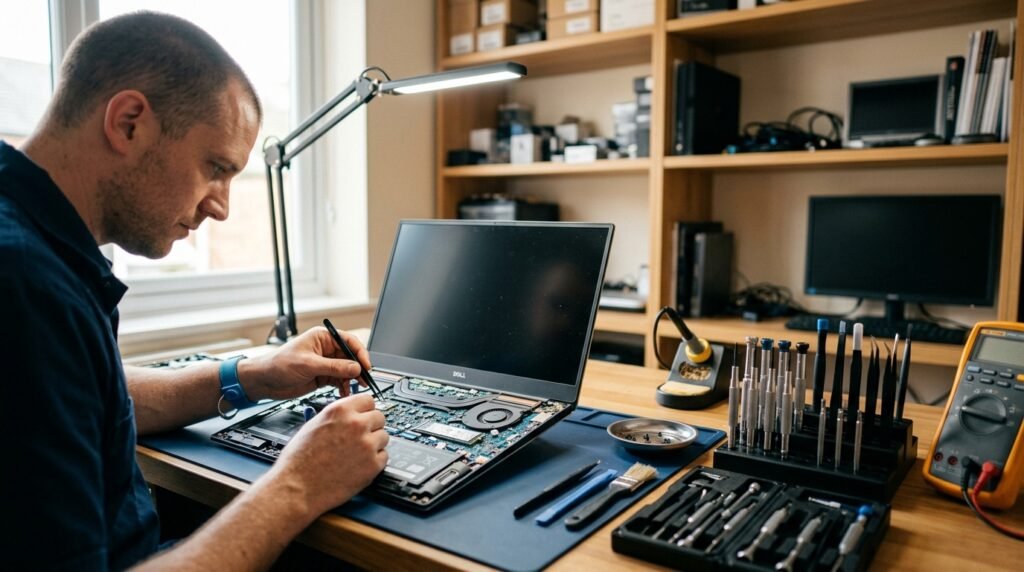
Timing matters too. A laptop still worth something as a trade-in at year four is worth almost nothing at year seven, so if replacement is clearly coming, doing it a year early while the old machine still has resale value often costs less overall than squeezing out the final year.
Frequently asked questions
Which laptop brand lasts the longest?
Apple. MacBooks average 6 to 8 years thanks to aluminum builds, efficient M-series chips, and long macOS support. Lenovo’s ThinkPad line is the closest challenger at 5 to 7 years, followed by Dell Latitude and HP EliteBook.
How many years should a laptop last before replacing it?
Plan on 4 to 6 years for a mid-range or better laptop. Replace it once it can no longer run a supported operating system, or when a repair quote passes half the cost of a comparable new machine.
Do gaming laptops wear out faster than regular laptops?
Yes. Gaming laptops from any brand average 3 to 5 years because hours of sustained high heat age the processor, battery, and solder joints faster than office work ever will. Good cooling habits stretch that.
Can a laptop last 10 years?
Physically, yes, especially a MacBook or business-class machine with a battery replacement along the way. In practice, software support ends first: security updates typically stop 7 to 9 years after a model launches.
Is it worth replacing a laptop battery instead of the laptop?
Usually, yes. A battery swap costs $50 to $150 on most serviceable machines and restores full portability. Only skip it if the laptop also has other failures or has already lost operating system support.
Conclusion
Expect 3 to 5 years from a budget laptop and 5 to 8 from a premium one. MacBooks lead at 6 to 8 years, ThinkPads, Latitudes, and EliteBooks follow at 5 to 7, and plastic consumer lines trail at 3 to 5. Buy the business line rather than the badge, keep the machine cool, manage the battery, and replace it when security updates end, not simply when it has a birthday.
Recommended Articles:
Where Is the Microphone on a Laptop? The Exact Spot and How to Find Yours
How Big Is an 11.6-Inch Laptop Screen? Real Dimensions and What Fits
Why Does My Laptop Shut Off Randomly? Causes and Fixes